
Out now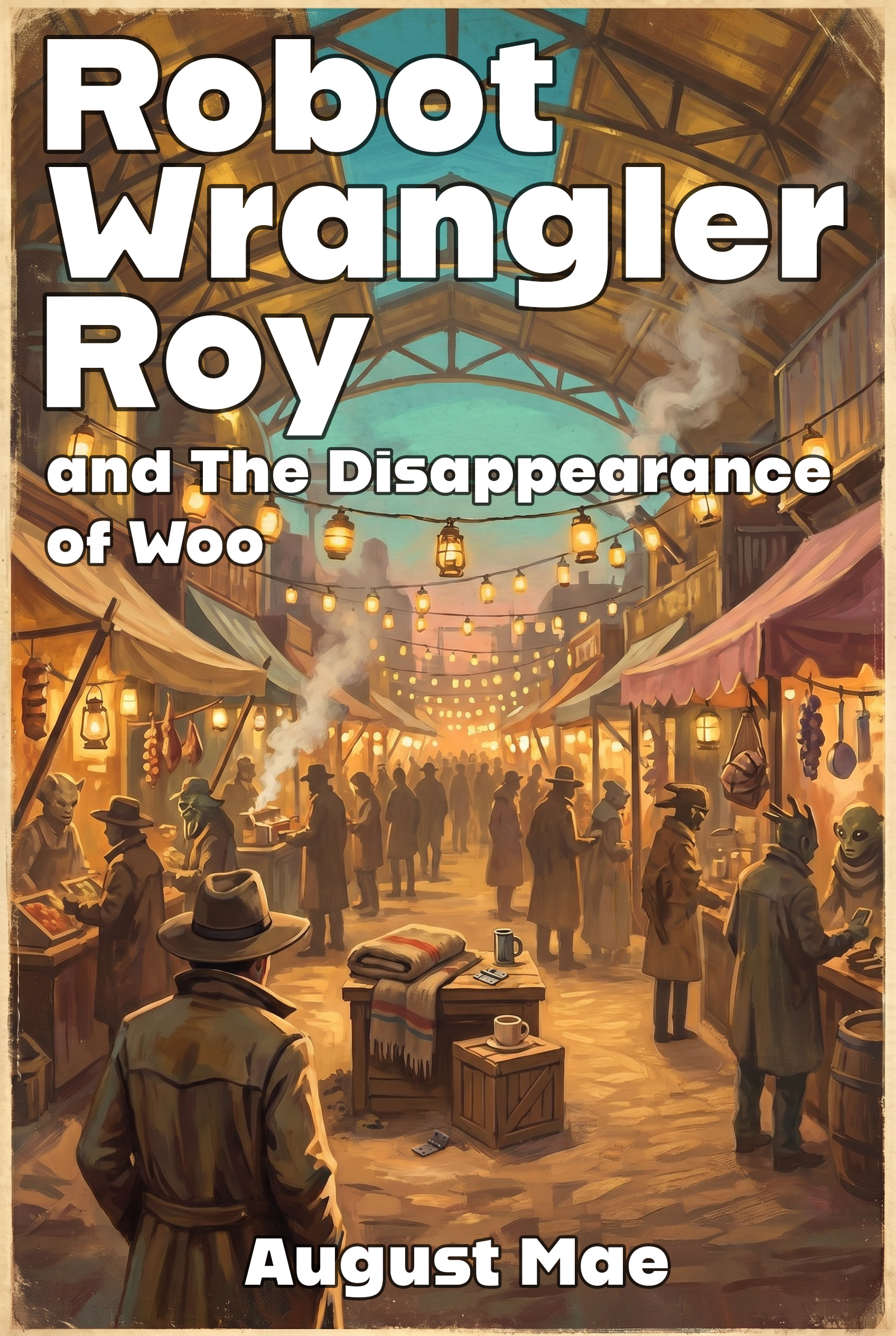
Book 03 · The Disappearance of Woo
The Disappearance of Woo
Everyone agreed the little robot was gone for good. Nobody had actually looked.
- Standalone
- Found family
- No on-page violence
Some machines break. The Sisters of Mercy are running exactly as they were made to. That is the whole trouble.
The barge The Marigold comes down through fog onto a half-forgotten moon out along the Scatter, answering a posted job. A salvage agent named Verity Quill has been sent to decommission an old order of care-robots and book the moon for reclamation, and she wants a wrangler to handle the part the paperwork cannot: the robots will not leave.
Roy takes the job the way he takes every job. Not to do what he is paid for, but to find out what the job actually is.
He finds out within the hour. High on the lamplit path stands a low mission-hospital where five gentle, age-worn Sisters keep the wards swept, the beds turned down, and the kettle always near the boil, against the day a patient comes. Below it lie the quiet bones of a town that left a generation ago, its houses hollow, its street nearly taken back by the fog. The town stopped needing the Sisters and never thought to say so. And the Sisters, faithful to a calling no one ever revoked, simply kept the lamps lit.
They do not greet the crew as a clearance party. They greet them as guests long awaited. Tea is pressed into cold hands. A bed is turned down. A chair is angled toward the warm for Bart, the crew's melancholy robot, before anyone has thought to ask, and Bart, so used to bracing for the moment he is no longer wanted, does not know what to do with being fussed over. He lets it happen anyway.
Verity reads the scene as waste: obsolete stock running warm for no customers, a glitch of devotion to be tidied off the ledger before the reclamation clock runs out. Roy reads it as a vocation with nowhere to land. He declines the easy paid handling, the brisk talking-out of holdouts, and does the slow thing instead. He sits. He watches. He listens. And the more he listens, the less the case looks like the one he was hired for.
Because the Sisters are not lost, or broken, or in any danger but the agent's clock. They are content. They have already chosen their place, and kept faith with it for longer than some of the crew have been alive. So the question stops being where these robots ought to go, and becomes something far harder, and far more tender: when a thinking being has named its own work and given its whole self to it, whose right is it to decide that the work no longer counts?
There is a second clock too, quieter than the agent's and far worse for being quiet, ticking in the eldest Sister's failing joints and guttering light. Roy has handled runaways and hold-outs and haunted machines and fleets gone silent. He has never had to stretch his creed this far: past finding the discarded a place, all the way to defending a being's right to keep the place it already chose, even against the kindest arithmetic in the Scatter.
Warm, funny, quietly wise, and a touch wistful, this is a comfort read for grown-ups about care, dignity, and the people, of every make, that a tidy world is too quick to call obsolete. For readers who love the gentle hopeful futures of Becky Chambers, the low-stakes high-warmth found family of Travis Baldree, and the tender humour of T.J. Klune.
Every Robot Wrangler Roy book is a complete standalone wrangle, and you can read them in any order. Put the kettle on. You will be looked after in here. Everyone on the station agreed the little robot was gone for good. Not one of them had actually looked.
The barge The Marigold has barely tied up at Tassel's Landing, a crowded bazaar-station out along the Scatter, all stalls and walkways, food-smoke and lantern-string, where thousands pass through and nobody is anybody's business for long, before the Landing's only piece of fresh news reaches the crew. Woo is gone.
Woo, a small, much-mended household robot, loved by a dozen stallholders and minded by none, has simply vanished. And the whole station has already grieved, shrugged, and moved on, because everyone knows what happens to a worn-out little unit that goes missing. Stolen for parts. Scrapped. Sold downwell. A sad, ordinary write-off. No point looking.
Roy is asked to confirm the loss. He cannot do it.
Because Roy is a robot wrangler, and where others reboot, wipe, or scrap, Roy listens. Every machine has a reason; he finds the reason. And a foregone conclusion, he knows within the hour, is not the same as the truth. A thing the whole Landing agrees on is simply a thing nobody has troubled to check. A small old robot who is genuinely loved does not vanish into thin air without leaving something behind, if only somebody will slow down enough to read it.
So Roy declines the easy, sad verdict and does the harder thing. You cannot listen to a robot who has gone, but you can read what it left behind, and Woo left a great deal. A shutter-hinge quietly mended one teatime, no thanks asked. A stray cat fed behind the noodle stall until it grew plump and stopped expecting to be chased. A stall minded for a friend whose child took poorly. A water-butt filled of an evening. A worry eased. The crowd remembers Woo only fondly and vaguely, as a kindness in the shape of a small robot, but Roy begins to read the kindnesses not as a sad inventory of a helper now lost, but as a trail.
The crew's good hearts make things worse before they make them better. Pip, certain she can crack it fast, chases the disappearance as a theft, hunting a culprit through the stalls, and a brisk crew sweep lands on frightened, half-remembering witnesses like an accusation. The very people whose small glimpses of Woo are the only thread holding the trail together go quiet and wary, and the thread very nearly snaps. Roy has to undo the harm the slow way, with empty hands and the wrong pace on purpose, while Hessa sets a kettle steaming on a busy corner and mends a frightened row the only way she knows.
And through all of it there is Bart, the crew's melancholy robot, who announces flatly and often that Woo is surely gone for good, and then goes down on his careful knees to look under one more crate, and one more after that. A missing friend is the one trouble Bart's gloom cannot make safe. He of all of them reads a vanished machine from the inside, and what he understands about why a small robot might go is the thing he is most carefully not saying, because saying it would feel a very great deal like hope.
Warm, funny, quietly wise, and threaded with the gentle pull of a kind mystery, this is a comfort read for grown-ups about the people, of every make, that a busy, careless world is too quick to write off. There is no villain here and no crime to punish, only a foregone conclusion to overturn and a small, much-loved robot to bring home. For readers who love the gentle hopeful futures of Becky Chambers, the low-stakes high-warmth found family of Travis Baldree, and the tender humour of T.J. Klune.
Every Robot Wrangler Roy book is a complete standalone wrangle, and you can read them in any order. Put the kettle on. You will be looked after in here.
Comfort reading in the company of
Becky Chambers / Travis Baldree / T.J. Klune
Get new-release news