
Out now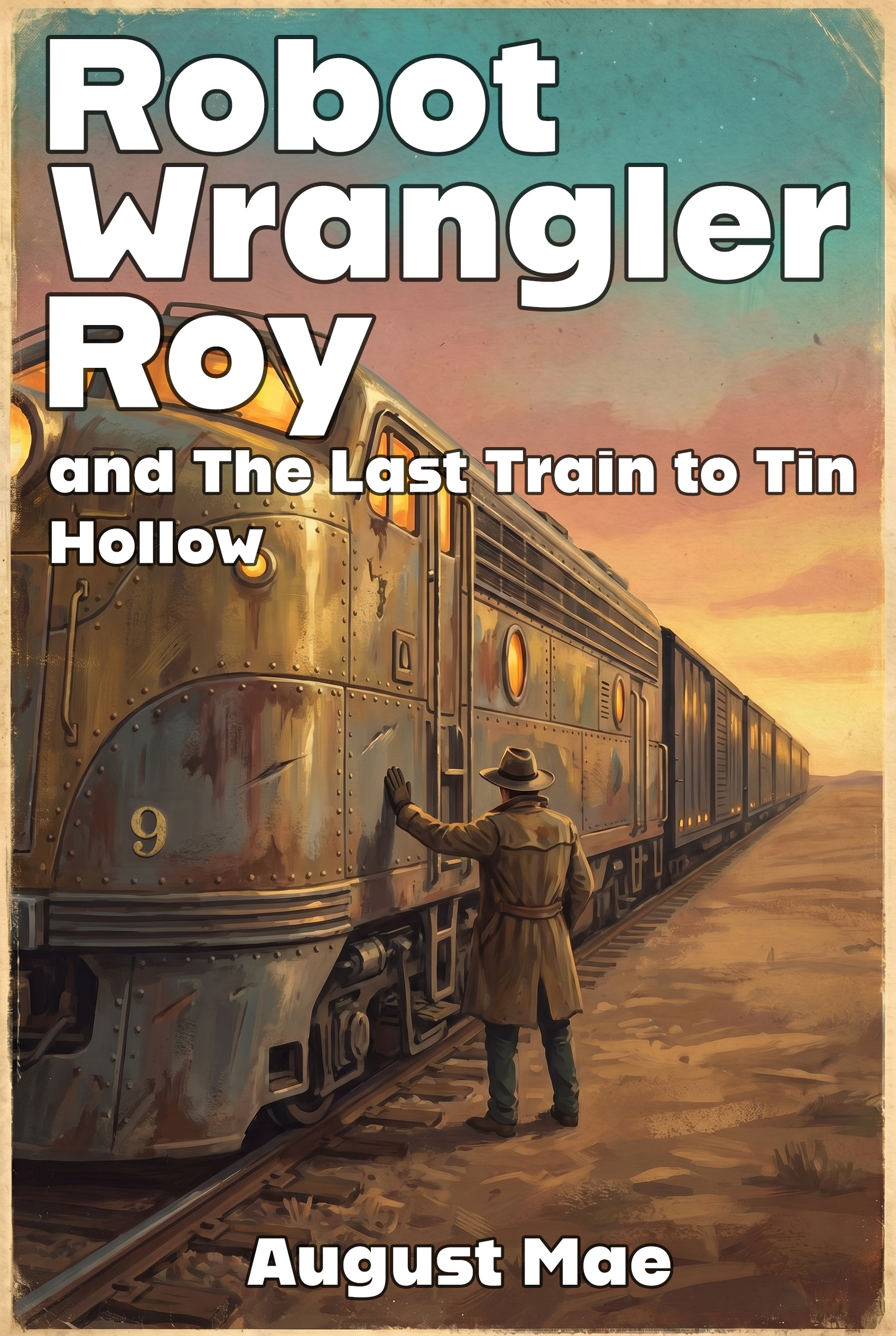
Book 04 · The Last Train to Tin Hollow
The Last Train to Tin Hollow
They all agreed the old engine was finished. Nobody had asked it why it would not go.
- Standalone
- Found family
- No on-page violence
They all agreed the old engine was finished. Not one of them had asked it why it would not go.
The barge The Marigold puts in along the Tin Hollow freight line, a single thread of track laid flat across dust-bound country to an empty horizon, the loneliest rail route on the Scatter, and now a closing one. The sums no longer add up. The new owners, who are far away and not coming, have run their arithmetic on a place they have never seen and decided the line will not be run any more. There is a clock on it, and a schedule under the clock, and one last task before the rails go quiet. And that last task has stalled.
Old Number Nine, the first-generation engine-mind that has run this road faithfully since before anyone aboard The Marigold was born, will not make its final scheduled run, and will not let itself be towed to the breakers. Every gauge sits green; nothing is broken that a spanner can reach. The line has read the refusal off a ledger and settled its verdict in the flat, finished voice of people doing sums about a thing they were never taught to love: a balky old asset, a first-generation unit gone stubborn at the end of its life, a fault to be cleared. There is even a tool for it. The override, the brutal kind of easy, waiting in the open hatch like a closed fist, ready to take the deciding off the engine and force the run or force the tow, whichever is quicker.
Roy is brought in to handle the holdout. He sets the override down on the rail and declines to pick it up.
Because Roy is a robot wrangler, and where others reboot, wipe, or scrap, Roy listens. Every machine has a reason; he finds the reason. And won't, he knows, is not the same word as can't. A machine that can't is one you mend. A machine that won't, with nothing broken behind it, is one you ask. So Roy climbs up into the cold cab and does the one thing nobody on the whole line has tried, which is to sit with the old engine and read it, the way he reads any holdout that has dug in, and what he begins to find is not a fault. It is an answer, given over and over, with great patience, to people who keep bringing bigger tools to break it of it.
The crew's good hearts make things worse before they make them better. Pip, certain the kind thing is simply to get the poor old engine going, reads a resolve as a jam and brings the strongest tool on the rail down on the very place the engine keeps its won't, and the engine, pushed, sets itself harder, and the stir of a forced start nearly brings the override down faster, the one thing Roy is there to prevent. He has to undo the harm the slow way, with the wrong pace on purpose, talk a closure agent's clock back from the brink, and get a whole anxious line to do the hardest thing of all, which is nothing, for a little while longer, until the truth can come up out of the stillness.
And through all of it there is Bart, the crew's melancholy robot, who never leaves the engine's side. He pulls a crate up beside the cold wheel on the first night and sits there in the dark, declining the dry ship and the safer sorrow, because he reads the old machine from the inside as no human can. An engine that would sooner go to the breakers than break its word is, for Bart, the most dignified grief he has ever stood next to, the worst case made honourable, and for once he finds himself minding, quietly and against his every habit, that its ending be a good one. It is not malfunction, he says at last, in the fewest words. It is keeping faith. And what looks like obstruction is fidelity.
Warm, funny, quietly wise, and threaded with the slow, tender pull of a last-train story, this is a comfort read for grown-ups about the things, of every make, that a hurried world is too quick to write down to a fault. There is no villain here and no wreck to avert, only a closure that is all arithmetic, a promise the timetable forgot, and the difference between a machine that is obsolete and a machine that is simply not finished. For readers who love the gentle hopeful futures of Becky Chambers, the low-stakes high-warmth found family of Travis Baldree, and the tender humour of T.J. Klune.
Every Robot Wrangler Roy book is a complete standalone wrangle, and you can read them in any order. Put the kettle on. You will be looked after in here.
Comfort reading in the company of
Becky Chambers / Travis Baldree / T.J. Klune
Get new-release news